Deprecated: Function WP_Dependencies->add_data() was called with an argument that is deprecated since version 6.9.0! IE conditional comments are ignored by all supported browsers. in /home/acroasis/public_html/wp-includes/functions.php on line 6131

Deprecated: Function WP_Dependencies->add_data() was called with an argument that is deprecated since version 6.9.0! IE conditional comments are ignored by all supported browsers. in /home/acroasis/public_html/wp-includes/functions.php on line 6131

250 and Counting: March 16, 1775: The Augusta Resolves

Over the last few days we’ve heard from several counties in Virginia sending delegates and instructions to the Second Virginia Convention, which would meet in another few days. Many of these counties published their instructions, called “Resolves,” in newspapers, so that anyone who was literate would know where the freeholders of those counties stood.

And today it’s Augusta County which weighed in by publishing their Resolves in the Virginia Gazette. Augusta County is quite close to both Fincastle and Botetourt counties, at what is now the western edge of the state. And we have to think that it’s meaningful that these communities, which were relatively far from where anything meaningful was taking place, was taking notice of those events and acting proactively, when only a few weeks earlier they would have been indifferent to it, because after all, it didn’t really affect them. Not yet, anyway.
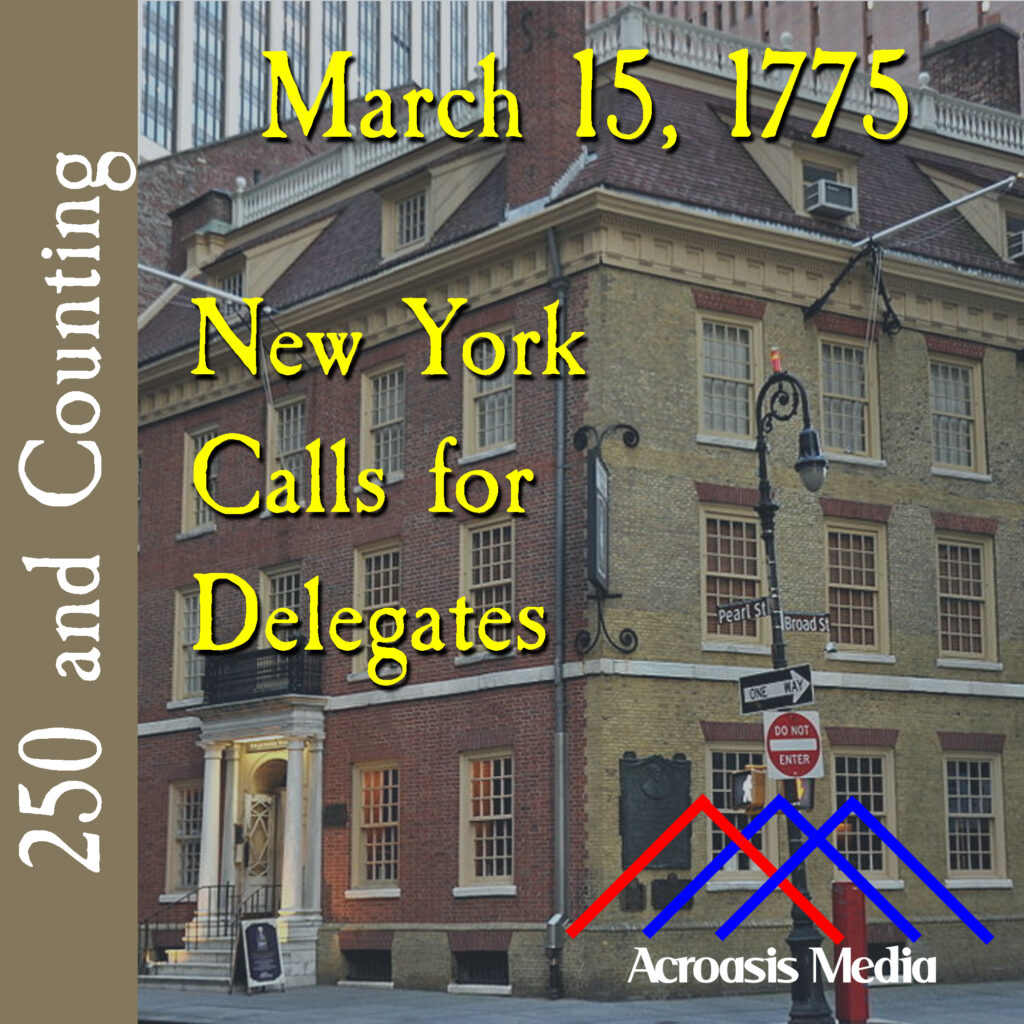
250 and Counting: March 15, 1775: New York Calls for Delegates

The New York colony gets a bad reputation for not having its act together when it came to American Independence, but the fact is, they were late to the party because they held on to their loyalty to the Crown until there was clearly no more reason to do so. Simply put, they were the last holdout.

What makes this extra remarkable is that most of the residents of New York really had no reason to be loyal to King George III, since they weren’t English-born, nor were they the descendants of Englishmen. Instead, most of them were descended from Dutch settlers from over a hundred years earlier.

But eventually they did come around, and when they did they showed an ability to snap into action quickly.

250 and Counting: March 14, 1775: Lord Dunmore Calls for Help

John Murray, the Fourth Earl of Dunmore, or more commonly Lord Dunmore, came to the Colonies in 1770 to become the Royal Governor of New York, but fate intervened and he wound up as the Royal Governor of Virginia instead.

He might have fared better in New York, but given the events of the Westminster Massacre you learned about yesterday, we’re not sure it would have made much difference. Dunmore wasn’t an especially good politician in general, and he didn’t hold the Colonists in an especially high esteem. And that’s the sort of thing that A) isn’t easily concealed, and B) doesn’t always go over well with your constituents. Not always.

250 and Counting: March 13, 1775: The Westminster Massacre

The Westminster Massacre was a seminal event in the history of both the United States and the State of Vermont.

At that time, Vermont was a disputed territory between New York, which was loaded with Loyalists, and New Hampshire, which had many Patriots. So when a group of five dozen New Yorkers showed up to break up a New Hampshire rally, there clearly wasn’t going to be a happy ending to the encounter.

But afterward, many New Yorkers were ejected from the area and nearly two years later, Vermont declared its independence from everybody, calling itself its own country rather than a British colony or an American state. It was a condition that lasted until 1791.

250 and Counting: March 12, 1775: Henry Eckford, Shipbuilder

Henry Eckford was born in Scotland on this day in 1775 and died in Constantinople in 1832. In between he spent a great deal of time in the Thirteen Colonies and then the United States, primarily in New York.

Eckford also dabbled in politics, serving in the state legislature and as a delegate to the Electoral College, before moving to the Ottoman Empire to assist with rebuilding the fleet there. He died quite suddenly there, probably of cholera, and his body was brought back to America, where he was buried in the graveyard at St. George’s Episcopal Church in Hempstead, L.I., along with his wife.

Coincidentally, many years ago I attended a wedding in that church. The weird bumps you make with history when you live on the East Coast, I tell you what.

(Above: Eckford’s grave; picture via findagrave.com)

250 and Counting: March 11, 1775: The Botetourt Resolutions

The Botetourt Resolutions was a document prepared by the freeholders of Botetourt County in Virginia that sent instructions to its representatives in the Second Virginia Convention.

Botetourt doesn’t get a lot of attention nowadays, largely because the Fincastle Resolutions arrived first and laid down nearly identical sentiments. But as we’ll see in the next few days, these two counties weren’t the only ones with the sort of opinions that they expressed.

250 and Counting: March 10, 1775: Daniel Boone Paves the Way for Kentucky

Because of popular culture in the 1950s and 1960s, Daniel Boone is probably one of the more colorful figures in American history. He was born in Pennsylvania, but it was in the frontier territory. He had little formal education, but he could read and write, even if his spelling was unorthodox. (In fact, oftentimes when he went on hunting or exploring expeditions, he was the only literate man in the group.) He was court-martialed at one point, but found Not Guilty and received a promotion afterwards.

He was a businessman, a politician, and an explorer, and it’s this last one that we’re going to look at today in 1775.

250 and Counting: March 9, 1775: The Restraining Act Moves Forward

We’ve talked about the New England Restraining Acts in the past, but now they’re being put to actual votes by Parliament. And on this day in 1775, they take another step forward when the House of Commons passes the measure.

With still more economic pressure placed on the Colonies (and the Act itself, by the way, not yet in full force), is it any wonder that the tensions escalated into actual war?

250 and Counting: March 8, 1775

It was on this day that an essay appeared in the Pennsylvania Journal advocating for the abolition of slavery. The content wasn’t a huge surprise for Pennsylvania, but the interesting thing is: the essay is known for being written under a pen name, and for a long time, people were pretty sure they knew who that person was.

They’re still not 100% positive.

250 and Counting: March 7, 1775

Topsfield, Massachusetts wanted to be prepared when the British came. What’s more, they wanted to ensure that their militiamen were drilled and fully outfitted should the need arise. To that end, they offered some of the best wages for their Minutemen.

But they had some trouble recruiting at first, until the town’s selectmen decided that their initial force wasn’t nearly formidable enough.