Deprecated: Function WP_Dependencies->add_data() was called with an argument that is deprecated since version 6.9.0! IE conditional comments are ignored by all supported browsers. in /home/acroasis/public_html/wp-includes/functions.php on line 6131

Deprecated: Function WP_Dependencies->add_data() was called with an argument that is deprecated since version 6.9.0! IE conditional comments are ignored by all supported browsers. in /home/acroasis/public_html/wp-includes/functions.php on line 6131

250 and Counting: February 4, 1775

Cover art for February 4, 1775: the front page of George III's New England Restraining Act

After the Boston Tea Party, Parliament enacted what they called the Coercive Acts and the Colonies called the Intolerable Acts. The Colonists were neither coerced, nor were the acts tolerated (hence the name). And you know that because we’ve told you this already several times.

In October 1774 the Continental Congress composed the “Petition to the King”, and as you’ll learn in greater detail tomorrow, it was pretty clear that the petition crossed an ocean and still managed to go nowhere. In fact…

At about the same time, King George III decided that New England needed some more “convincing” to fall into line. This was the beginning of the New England Restraining Act. As the name suggests, it affected mostly the New England colonies, but people in the other colonies took notice and wondered “Hey, this could happen to us too, couldn’t it?” As a result, everyone continued moving down the path they fervently hoped they wouldn’t travel.

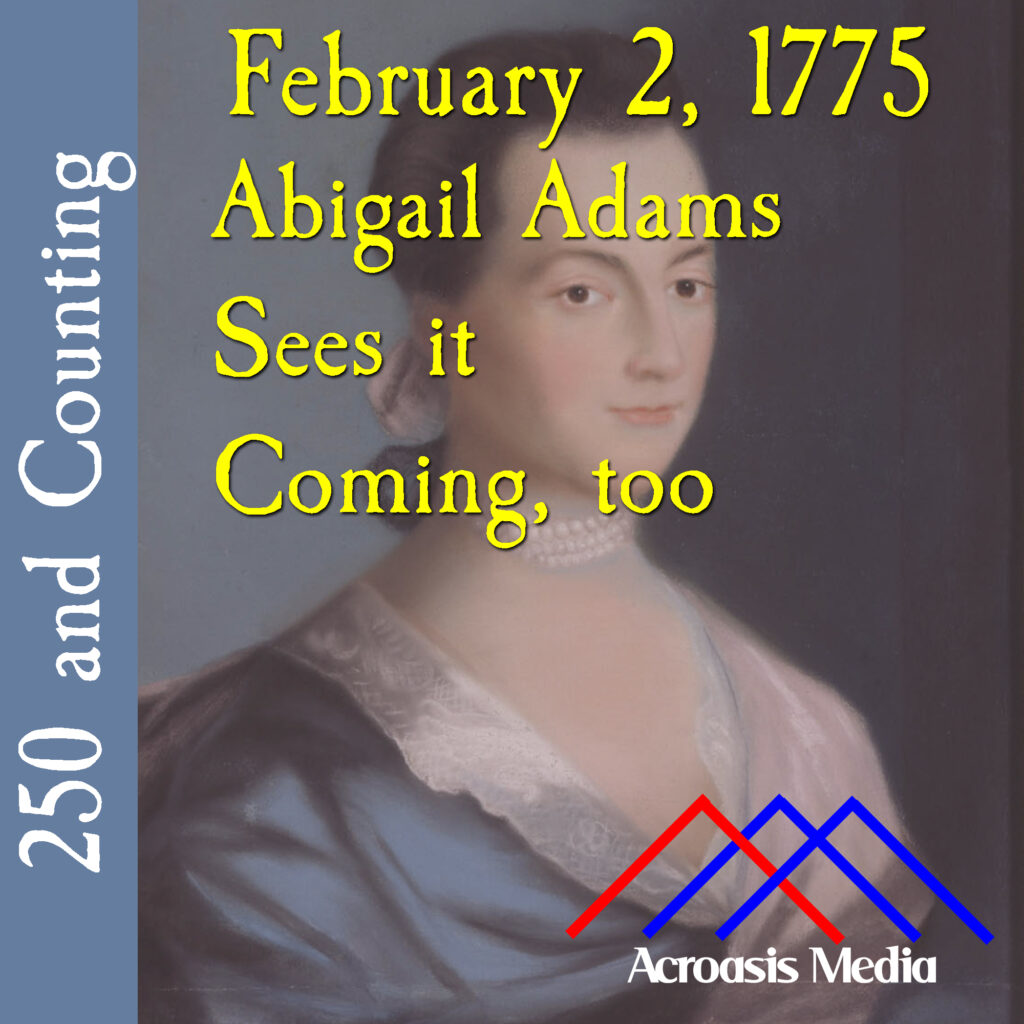
250 and Counting: February 2, 1775

Cover art for February  2, 1775: portrait of Abigail Adams by Benjamin Blyth, in 1766.

After the Boston Tea Party, the government in Britain enacted what they called the Coercive Acts, or what the Colonists called the Intolerable Acts. (From here, it doesn’t feel like one name was any better-sounding than the other.)

Because the Colonists were still hoping to preserve a decent relationship with the Mother Country, the First Continental Congress met in Philadelphia and put together a letter to the king, which said in essence, “We’re very loyal to you, O King, but it’s been a year and enough is enough. Maybe you could prevail upon Parliament to dial it back a little bit, hm?”

That was in October of 1774. Of course, documents moving slowly and all that, the reply from the king didn’t come back for a couple of months, and at the heart of it was George affirming his faith in Parliament’s actions, and nothing’s going to change for the forseeable future.

Both John and Abigail Adams, in different places at the time and in separate letters to friends, each relayed to friends their opinion that the tipping point had passed and that war was probably inevitable.

Guest Voice: Shannon Call, who needed a lot of convincing to get near a microphone.

250 and Counting: February 1, 1775

Cover art for February 1, 1775: Portrait of John Hancock.

Before the shooting started, Boston appeared to be the place which gave King George III the most hassles. But to be fair, Boston is the place that the British seemed to provoke more than the other Colonies, so it kind of evened out in the end.

When the Intolerable Acts dissolved the existing government in Massachusetts, the locals said, “Whatever” and convened anyway that same summer. But there’s no denying the results: they did all the things that a government is supposed to do, and the locals pretty much ignored whatever apparatus was set up by the British.

There were three Provincial Congresses in Massachusetts, but by the time the Third one convened, much of what they did was rendered unnecessary because the war had turned “hot” and other structures were in place to do the job.

250 and Counting: January 19, 1775

Cover art for January 19, 1775: An image of the Petition to the King.

Most people (we think) have this popular notion of American history involving the British imposing taxes and massacreing people in Boston and the Colonists responding with an indignant “Oh, we need to dump some tea and write a Declaration of Independence and take up arms and shoot those red-coated monsters right now!”

But if you’ve been listening to this show for the past couple of weeks, you already know that wasn’t the case. There were many, many attempts to seek out a peaceful solution to the troubles going on. Some of them were rather covert: backchannel people talking to one another, negotiating quietly, Others, of course, were overt. And today we’ll be talking about one of those. It was an attempt by the First Continental Congress to bring up their issues, ask for relief and simultaneously affirm their allegiance to the King.

(Spoiler Alert: it didn’t work.)

250 and Counting: January 17, 1775

Cover art for January 17, 1775: the Second Regiment in South Carolina, late 1775

In the early 1770s, the American colonies began feeling the need to defend themselves against British pressures. In some cases the activity was political, but there were plenty of people who saw that there could conceivably be a need to take up arms at some point, especially given the way they interpreted the Intolerable Acts. Although in popular culture, Boston was the center of attention for this sort of thing, the fact is that small, informal militias began springing up all the way up and down the Eastern Seaboard. These soon gave way to more formalized groups which were funded by their respective governments. And when hostilities finally broke out, these militias quickly reorganized themselves into official Regiments. Today we’ll learn about the militias in South Carolina.

250 and Counting: January 16, 1775

Cover art for January 16, 1775: A closeup of a plaque in Charleston SC, commemorating the Edenton Tea Party

We suppose there’s something kind of heroic and–dare we say it, romantic–about the idea of a bunch of men dressing up as Native Americans, sneaking onto a boat and throwing 342 chests of tea into Boston Harbor. And as an overt act of rebellion, it certainly made a splash (you should excuse the expression).

But Boston wasn’t the only city holding tea parties. Edenton, North Carolina had a tea party of its own, and it’s notable for several reasons:

First, who was involved in it;

Second, the fact that it launched an interesting fashion trend (it’s not like everybody was dressing up like Native Americans after the Boston event, right?),

And Third, that it actually got some attention.

And while all of these are unusual, what’s more unusual is that it didn’t capture the imagination of people enough to endure in popular culture the way Boston did. Maybe becuase it was done in a more genteel manner, maybe because there was something special about the participants…it’s hard to tell froma modern-day standpoint. But we think you’ll agree that it’s a fascinating story.

Guest Voice: Lorene Childs

250 and Counting: January 14, 1775

Cover art for January 14, 1775: portratt of Lord Dartmouth

William Legge was the Second Earl of Dartmouth and, just before the hostilities between the Colonists and the British started in earnest, was also the Secretary of State for the Colonies and the First Lord of Trade.

Lord Dartmouth noticed that people throughout the Colonies appeared to be preparing for all-out war, so he sent a letter to the colonial governors, essentially ordering them to embargo imports of weapons or ammunition. In doing this, he was basically fulfilling his duty to the Crown.

Simultaneously, however, he was trying to employ backdoor diplomacy tactics to negotiate a peace. Benjamin Franklin was among the people with whom he communicated. But it’s tough to argue for peace when your troops are occupying Boston, and his actions ultimately led to the Gunpowder Plot, and the war heating up for good at Lexington and Concord just a few months later.