Deprecated: Function WP_Dependencies->add_data() was called with an argument that is deprecated since version 6.9.0! IE conditional comments are ignored by all supported browsers. in /home/acroasis/public_html/wp-includes/functions.php on line 6131

Deprecated: Function WP_Dependencies->add_data() was called with an argument that is deprecated since version 6.9.0! IE conditional comments are ignored by all supported browsers. in /home/acroasis/public_html/wp-includes/functions.php on line 6131

250 and Counting: February 2, 1775

Cover art for February  2, 1775: portrait of Abigail Adams by Benjamin Blyth, in 1766.

After the Boston Tea Party, the government in Britain enacted what they called the Coercive Acts, or what the Colonists called the Intolerable Acts. (From here, it doesn’t feel like one name was any better-sounding than the other.)

Because the Colonists were still hoping to preserve a decent relationship with the Mother Country, the First Continental Congress met in Philadelphia and put together a letter to the king, which said in essence, “We’re very loyal to you, O King, but it’s been a year and enough is enough. Maybe you could prevail upon Parliament to dial it back a little bit, hm?”

That was in October of 1774. Of course, documents moving slowly and all that, the reply from the king didn’t come back for a couple of months, and at the heart of it was George affirming his faith in Parliament’s actions, and nothing’s going to change for the forseeable future.

Both John and Abigail Adams, in different places at the time and in separate letters to friends, each relayed to friends their opinion that the tipping point had passed and that war was probably inevitable.

Guest Voice: Shannon Call, who needed a lot of convincing to get near a microphone.

250 and Counting: February 1, 1775

Cover art for February 1, 1775: Portrait of John Hancock.

Before the shooting started, Boston appeared to be the place which gave King George III the most hassles. But to be fair, Boston is the place that the British seemed to provoke more than the other Colonies, so it kind of evened out in the end.

When the Intolerable Acts dissolved the existing government in Massachusetts, the locals said, “Whatever” and convened anyway that same summer. But there’s no denying the results: they did all the things that a government is supposed to do, and the locals pretty much ignored whatever apparatus was set up by the British.

There were three Provincial Congresses in Massachusetts, but by the time the Third one convened, much of what they did was rendered unnecessary because the war had turned “hot” and other structures were in place to do the job.

250 and Counting: January 31, 1775

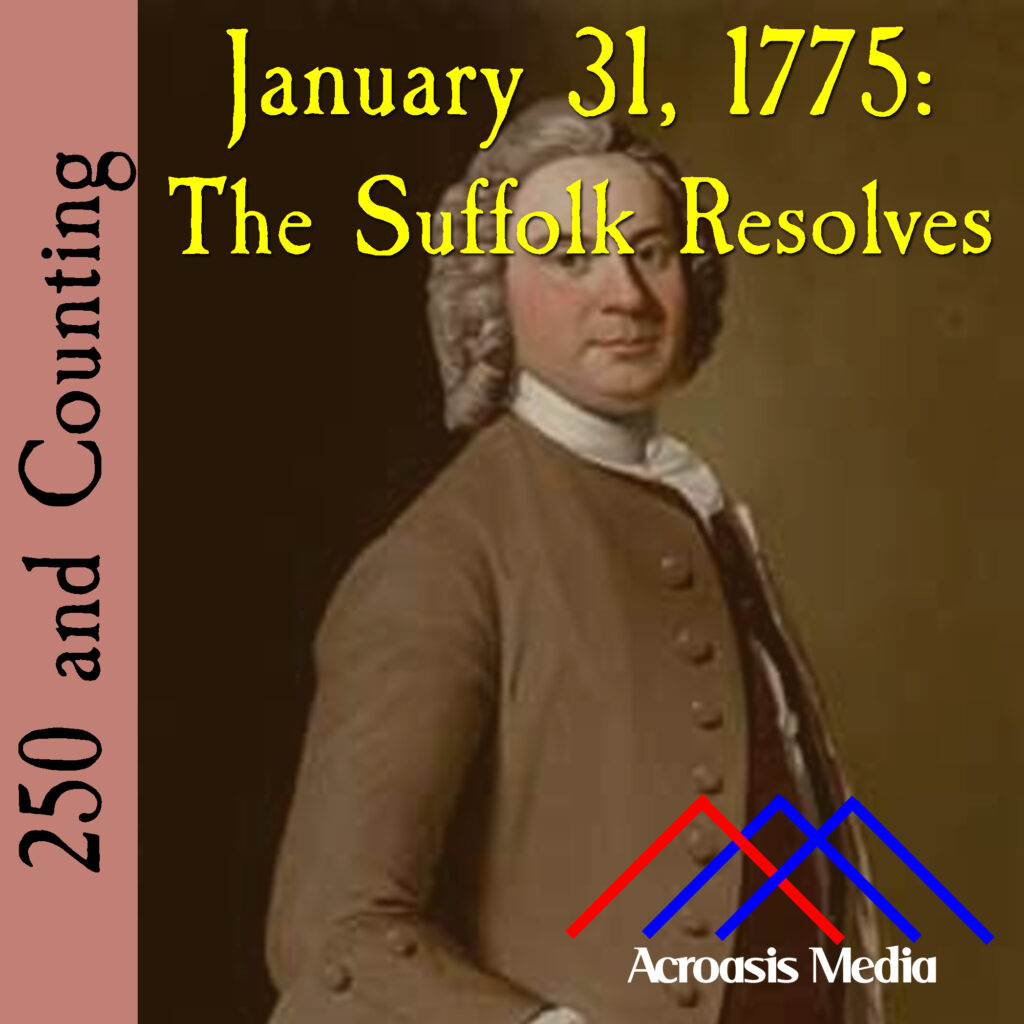
Cover art for January 31, 1775: portrait of John Rowe

John Rowe was one of those guys who always seemed to be nearby when something happened, but he also manged to let it be known that he was nowhere nearby when that thing happened. For instance, he was the guy who owned the tea that got dumped into Boston Harbor, but he was “sick” that day and couldn’t have possibly participated in the event.

The Suffolk Resolves was a document written to formally reject the Massachusetts Government Act, but it was so well-crafted that other colonies were able to use it as a model for their Resolves. And Rowe was around to hear what King George III had to say about that document, but his opinion isn’t as clear as you might think.

250 and Counting: January 30, 1775

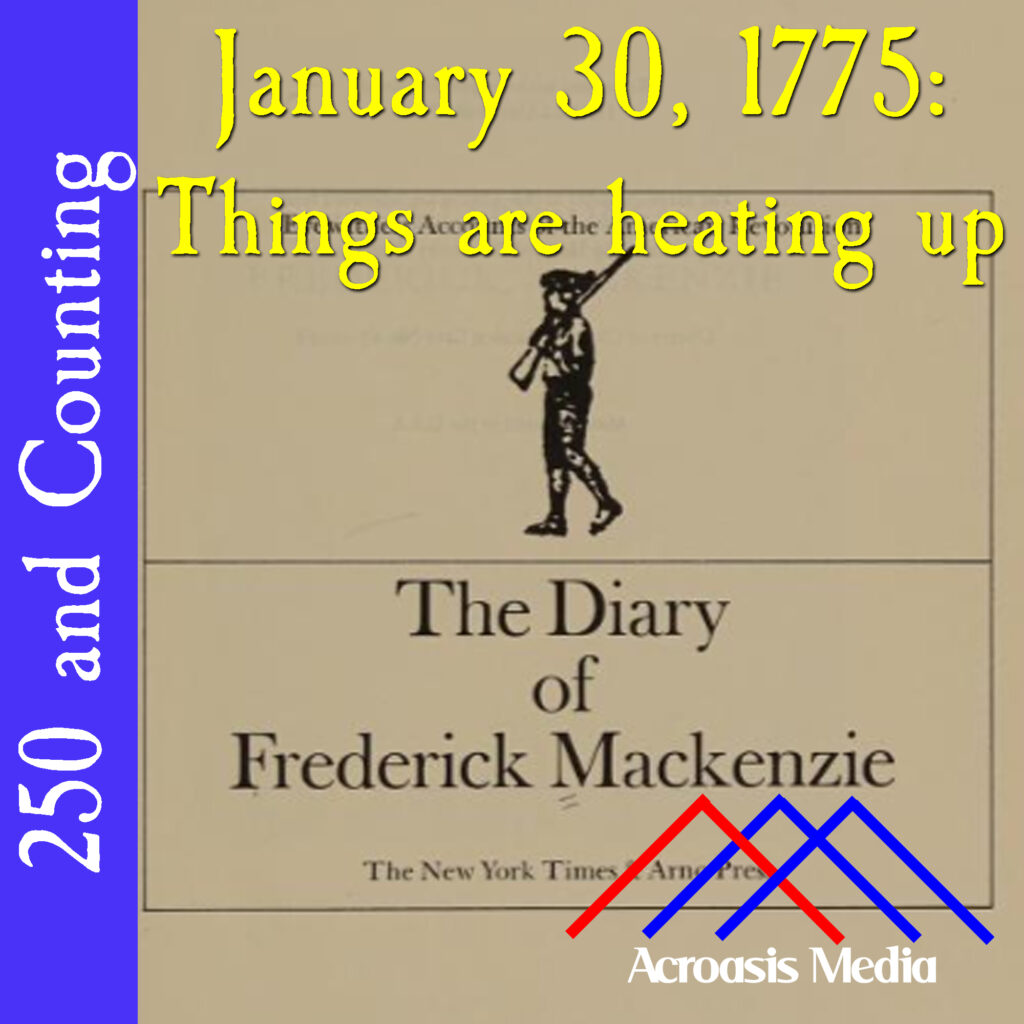
Cover Art for January 30, 1775: the cover of the Diary of Frederick Mackenzie

By this time in 1775, tensions between the British and the Colonists in Boston were especially high. The Boston Tea Party resulted in several thousand troops being sent in to restore and maintain order, and Americans being Americans, even before there was an America, nearly every home had plenty of arms and ammunition, or at the very least the village had a gunpowder magazine, where the explosives were stored safely but in central, easy-to-access locations.

To be on the safe side, General Gage ordered that the magazine nearest to Boston be emptied and the gunpowder brought back into the city under cover of night. The operation was successful, but trust of the British was only further eroded by this action. Ultimately it led to the Colonists continuing to arm themselves, but to do it more covertly. It wouldn’t be long before open war was waged.

250 and Counting: January 29, 1775

Cover art for January 29, 1775: portrait of Benjamin Franklin.

Benjamin Franklin, like many of our Founding Fathers, was interested in repairing the relationship between the Colonies and England, at least early on.

What’s more, he thought that others in similar positions would be of a similar mind, so he was rather dismayed to learn that this wasn’t the case; in fact, when a sheaf of letters written by Thomas Hutchinson and Andrew Oliver made their way into his hands, he was rather dismayed to learn that they were badly misleading Parliament with regard to the situation in the Colonies.

So Franklin leaked the letters to the Speaker of the Massachusetts Assembly, saying they could be read but not copied. But Franklin didn’t heed his own advice: “Three people may keep a secret, if two of them are dead.” The letters got out anyway, and they were published in the Boston Gazette a few months later. For his efforts, Franklin was humiliated in a Privy Council hearing and stripped of his title of Postmaster General of the Colonies. On the other hand, this was the event that tipped Benjamin Franklin firmly over to the cause of liberty.

250 and Counting: January 27, 1775

Cover Art for January 27, 1775: A portrait of General Gage

William Legge was the second Lord Dartmouth and the Secretary of State for the Colonies from 1772 to the end of 1775. He was also step-brother to Lord North, who gets a mention in this episode.

While he was a supporter of the constitutional supremacy that Parliament maintained they held over the Colonies, Lord Dartmouth was also the Colonists’ best hope for some form of reconciliation.

Dartmouth’s resolve to achieve this reconciliation was damaged by the Boston Tea Party, so by this time he ordered Gage to put some extra pressure on the Colonists. Unfortunately this backfired badly and led to the battles at Lexington and Concord, which we’ll talk about in a future episode. Even after that, however, Legge couldn’t fully support armed coercion against the Americans, and he resigned his post in November, which basically ended his political career.

Legge was considered by many to be very pious and gentle, to the point where some people called him “the Psalm Singer.” He died in 1801, nearly forgotten. Even his final resting place no longer exists, as it was destroyed by the Nazis during World War II.