Deprecated: Function WP_Dependencies->add_data() was called with an argument that is deprecated since version 6.9.0! IE conditional comments are ignored by all supported browsers. in /home/acroasis/public_html/wp-includes/functions.php on line 6131

Deprecated: Function WP_Dependencies->add_data() was called with an argument that is deprecated since version 6.9.0! IE conditional comments are ignored by all supported browsers. in /home/acroasis/public_html/wp-includes/functions.php on line 6131

250 and Counting: February 2, 1775

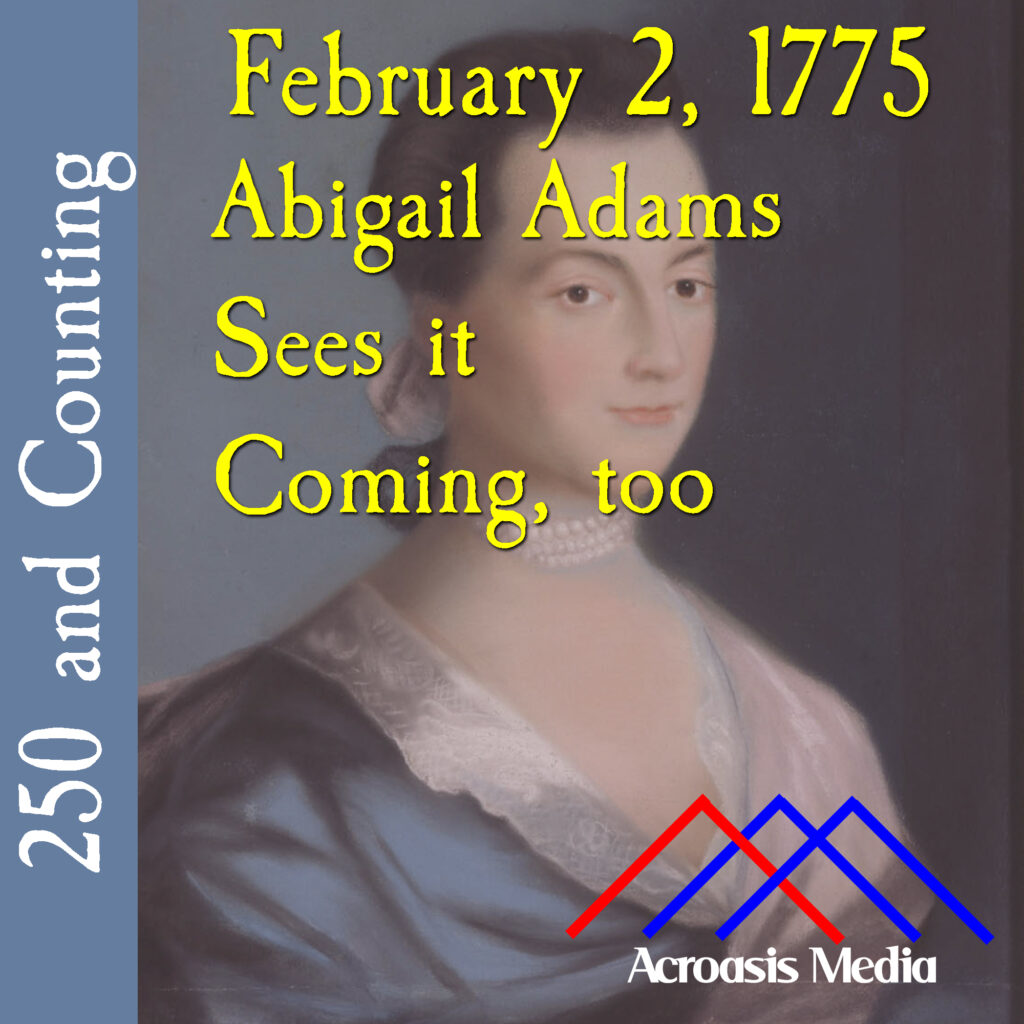
Cover art for February  2, 1775: portrait of Abigail Adams by Benjamin Blyth, in 1766.

After the Boston Tea Party, the government in Britain enacted what they called the Coercive Acts, or what the Colonists called the Intolerable Acts. (From here, it doesn’t feel like one name was any better-sounding than the other.)

Because the Colonists were still hoping to preserve a decent relationship with the Mother Country, the First Continental Congress met in Philadelphia and put together a letter to the king, which said in essence, “We’re very loyal to you, O King, but it’s been a year and enough is enough. Maybe you could prevail upon Parliament to dial it back a little bit, hm?”

That was in October of 1774. Of course, documents moving slowly and all that, the reply from the king didn’t come back for a couple of months, and at the heart of it was George affirming his faith in Parliament’s actions, and nothing’s going to change for the forseeable future.

Both John and Abigail Adams, in different places at the time and in separate letters to friends, each relayed to friends their opinion that the tipping point had passed and that war was probably inevitable.

Guest Voice: Shannon Call, who needed a lot of convincing to get near a microphone.

250 and Counting: February 1, 1775

Cover art for February 1, 1775: Portrait of John Hancock.

Before the shooting started, Boston appeared to be the place which gave King George III the most hassles. But to be fair, Boston is the place that the British seemed to provoke more than the other Colonies, so it kind of evened out in the end.

When the Intolerable Acts dissolved the existing government in Massachusetts, the locals said, “Whatever” and convened anyway that same summer. But there’s no denying the results: they did all the things that a government is supposed to do, and the locals pretty much ignored whatever apparatus was set up by the British.

There were three Provincial Congresses in Massachusetts, but by the time the Third one convened, much of what they did was rendered unnecessary because the war had turned “hot” and other structures were in place to do the job.

250 and Counting: January 23, 1775

Cover Art for January 23, 1775: A portrait of Mercy Otis Warren

Awhile back we talked about a Loyalist who wrote an opinion piece under the pen name “Massachusettensis” (which we may have mocked a little bit but it’s just the Latin word for the Colony/State). His rhetoric angered John Adams to the point where he felt compelled to respond in kind, and he did so using a pen name of his own: Novanglus.

We’ll learn about Adams’ first response to Massachusettensis, but we’ll also discover that there may be another reason this particular essayist caught Adams’ imagination.

Also on this day, Mercy Otis Warren opens a new play whose plot may lie a little too close to real life.

250 and Counting: January 21, 1775

Cover Art for January 21, 1775: A portrait of John Adams

As we’ve noted a few times, the Colonists in general didn’t want war with Britain; in fact most of them were pretty sure they were going to get wiped out should it come to that.

Even our most famous Patriots of the time, such as John Adams, Benjamin Franklin, Thomas Jefferson and others, spent enormous amounts of time trying to engage the British peacefully. For a long time, any petitions sent to King George III had some form of “Hey, we’re totally loyal to you, can you please address this for us, your loyal subjects? Please?” somewhere in the document.

Thus it was that John Adams composed a letter to a friend of his in London, whose identity remains unknown to modern-day historians. He pinpoints the day he thinks things started to go wrong, and he notes that there’s a spirit on this side of the pond which shouldn’t go ignored.

250 and Counting: January 9, 1775

Cover art for January 9, 1775: A portrait of Daniel Leonard, a British Loyalist who wrote under the pen name "Massachusettensis."

Daniel Leonard was the son of a prominent family in the ironworks industry. He lived in Taunton, Massachusetts until shortly after he accepted a position working for the Royal Governor of the state, at which point he became unpopular enough that he was forced to move to Boston, which was under British occupation at the time.

It makes sense, then, that Leonard put pen to paper and wrote essays to be published in the Boston Gazette under the pen name “Massachusettensis.” (What doesn’t make sense, 250 years later, is why he chose such a peculiar name. At least, not to us.) He began writing these pieces in December 1774 but it was the one published on this day in 1775 that finally set John Adams to writing replies under a pen name of his own. This back-and-forth continued for about three months, until a major event escalated the tensions between the Crown and the Colonies to the point where the exchange of essays became moot.

250 and Counting: January 6, 1775

Cover art for January 6, 1775: A map of the New York area from that year

The impression that most people have of John Adams, it seems, comes from one of two places. It’s either William Daniels’ portrayal of him in the play and film 1776 (and we’re big fans of that particular bit of cinema), or it’s Paul Giamatti’s portrayal in the seven-part miniseries on cable TV. Both stories had their charms, and both took some liberties with the facts. (Oddly, both of them showed Benjamin Franklin being carried in to the Second Continental Congress, but that didn’t happen until the Constitutional Conventions eleven years later.) The bottom line is that Adams was a complex man and a very smart one who had the ability to see the bigger picture, as they say.

George Washington was also a well-rounded person, as you no doubt discovered in the January 1 episode. Early in 1775 Washington wore multiple hats. He was a delegate to the First Continental Congress, he was responsible for training militiamen in Virginia, and he was unofficially the Commander-in-Chief of the army, except there wasn’t one quite yet.

Today we’re looking at some correspondence from Adams to Washington, and we’ll learn in a future episode just how seriously Washington took his warnings.