Deprecated: Function WP_Dependencies->add_data() was called with an argument that is deprecated since version 6.9.0! IE conditional comments are ignored by all supported browsers. in /home/acroasis/public_html/wp-includes/functions.php on line 6170

Deprecated: Function WP_Dependencies->add_data() was called with an argument that is deprecated since version 6.9.0! IE conditional comments are ignored by all supported browsers. in /home/acroasis/public_html/wp-includes/functions.php on line 6170

250 and Counting: February 14, 1775

When it comes to Black people and their role in the American Revolution, the one name that most people appear to remember is that of Crispus Attucks, largely because he was the first person killed in the Boston Massacre, and that event is thought of as the beginning of the Revolutionary War, therefore it’s significant that the first person to die in the name of American freedom was a person of color.

Other people, more fussy about events, would say that Lexington & Concord was the beginning of the war. The reasoning behind that is that it’s the first event in a series of hostile actions that took place close to one another. But the real argument is that most historical events of this nature don’t have definitive “beginning” and “ending” points; it’s much like a roll of paper towels. Sure, there are perforations marking each sheet, but you know for a fact that when you pull one off, it’s going to tear at an oddball angle and those perfectly rectangular sheets are a rarity.

The fact is, however, that over 100 Black men fought as part of the militia in the opening battles of the Revolution. Here’s the story of one of the first.
250 and Counting: February 13, 1775

Here’s a peek behind the curtain: Mike and Claude do their own research for the individual shows, though Mike did the initial setups for the dates. So he’s the one who figured out what happened when, and then they each do the deeper research for the episodes they record.

So Mike probably had no idea that there was a familial connection to this episode for Claude. For what it’s worth, neither did Claude, until he started looking into the story of Nathaniel Gorham. So if Mike had been recording this episode, it’s likely that he wouldn’t have had anything to say about it other than “Oh, fun coincidence.”

We’re only sad that we couldn’t find a portrait of Nathaniel; we have no idea whether there’s a family resemblance.

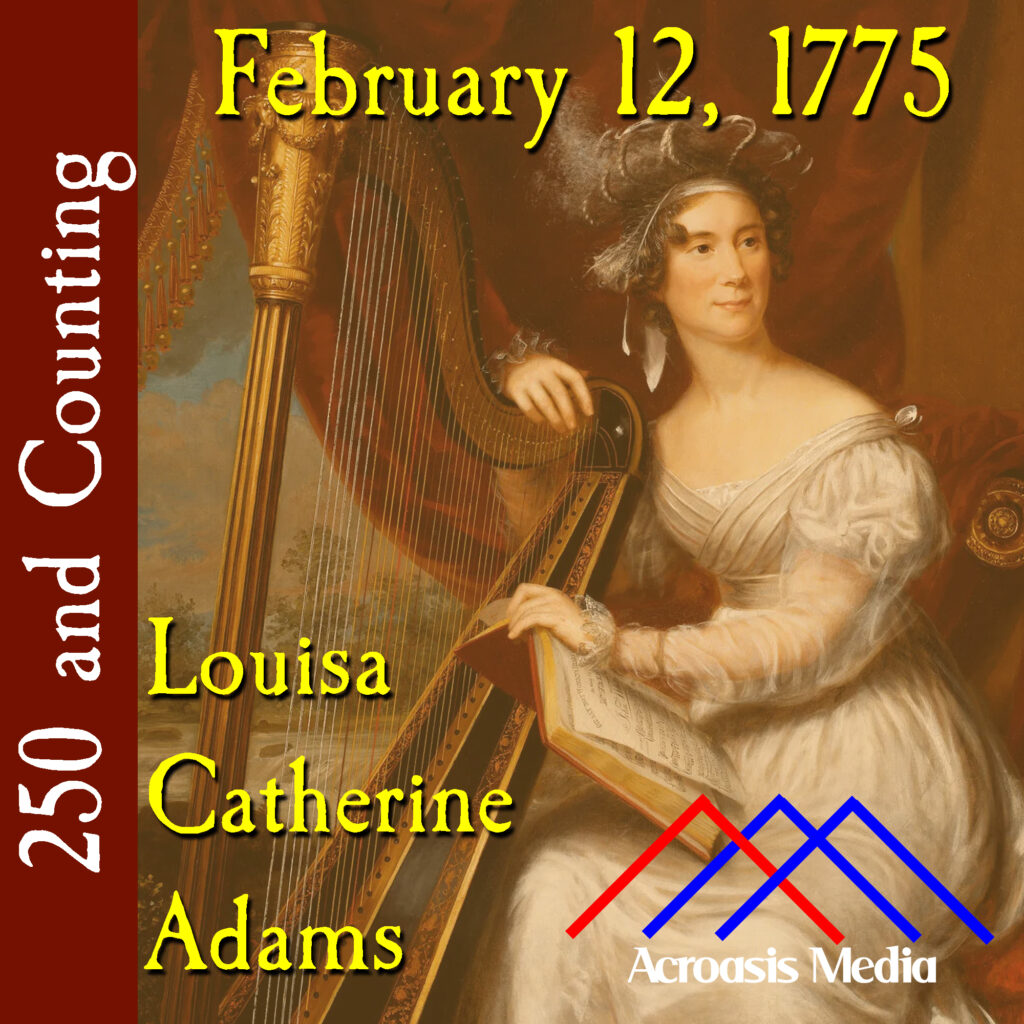
250 and Counting: February 12, 1775

We realize that this is going to come as a huge surprise to you, but when the future Louisa Catherine Adams met her future mother-in-law, it was not an auspicious occasion.

This delayed—but did not prevent—Louisa from marrying John Quincy Adams, but Abigail Adams didn’t have a lot of respect for Catherine for many years.

In the meantime, she and John Quincy had some ups and downs in their marriage, but in the end it appears that they were able to reconcile all the rough patches until the very end.

250 and Counting: February 11, 1775

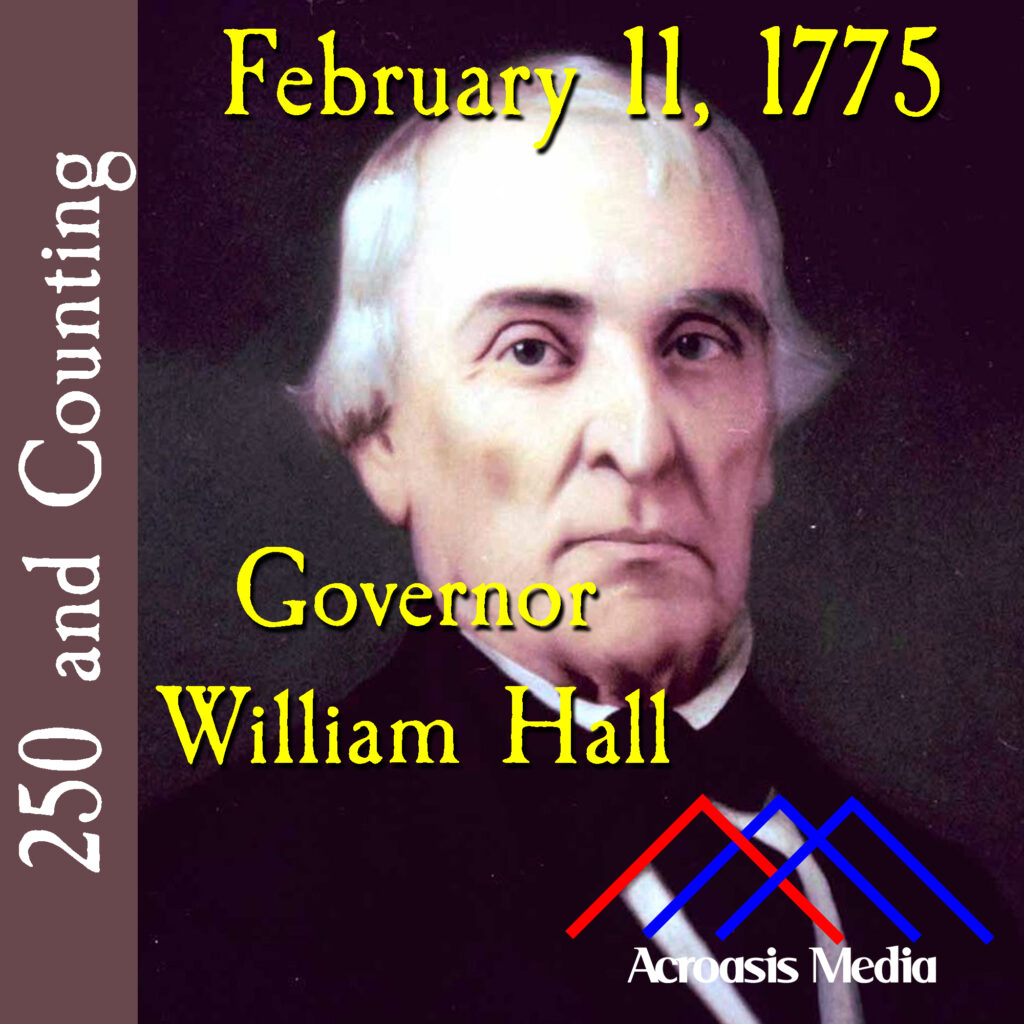
There are many events in the life of William Hall that could be ascribed to just plain luck on his part, and others which could conceivably tied to some shrewd timing on his part. But in the end, we think we’re going with luck.

If he hadn’t survived two Cherokee ambushes, if he hadn’t been an officeholder previously, if he hadn’t been the Speaker of the Senate when a scandal broke out…things could have turned out very differently for our friend William.

But William was also smart enough to walk away when the walking was good, and he lived to a ripe old age (81).

250 and Counting: February 10, 1775

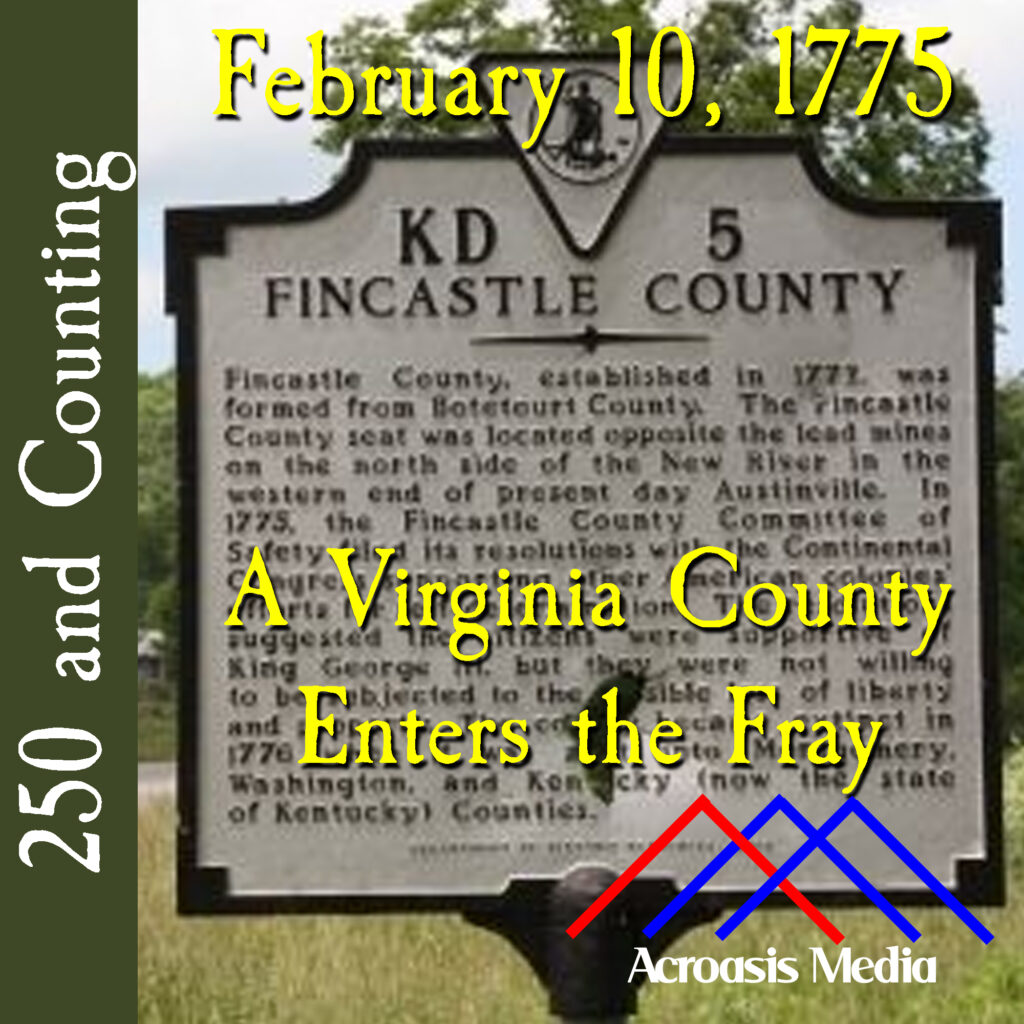
While Massachusetts, and Boston in particular, were getting a lot of attention from the British, it’s not as though the other colonies sat back and watched everything happening from afar.

To a certain extent they did do that, but they also had problems of their own to deal with. In some of the more southern states, the biggest problem was dealing with some of the natives, who had this odd insistence that they were there first and were somehow entitled to this land that had been stolen from them. This often led to multiple skirmishes on the western edges of the colonies. Plus, much of the Intolerable Acts didn’t really affect them…yet.

But Fincastle County in Virginia, while not the first territory outside Massachusetts to take up the cause, was probably one of the more gung-ho territories when it came to spelling out their intent.

250 and Counting: February 9, 1775

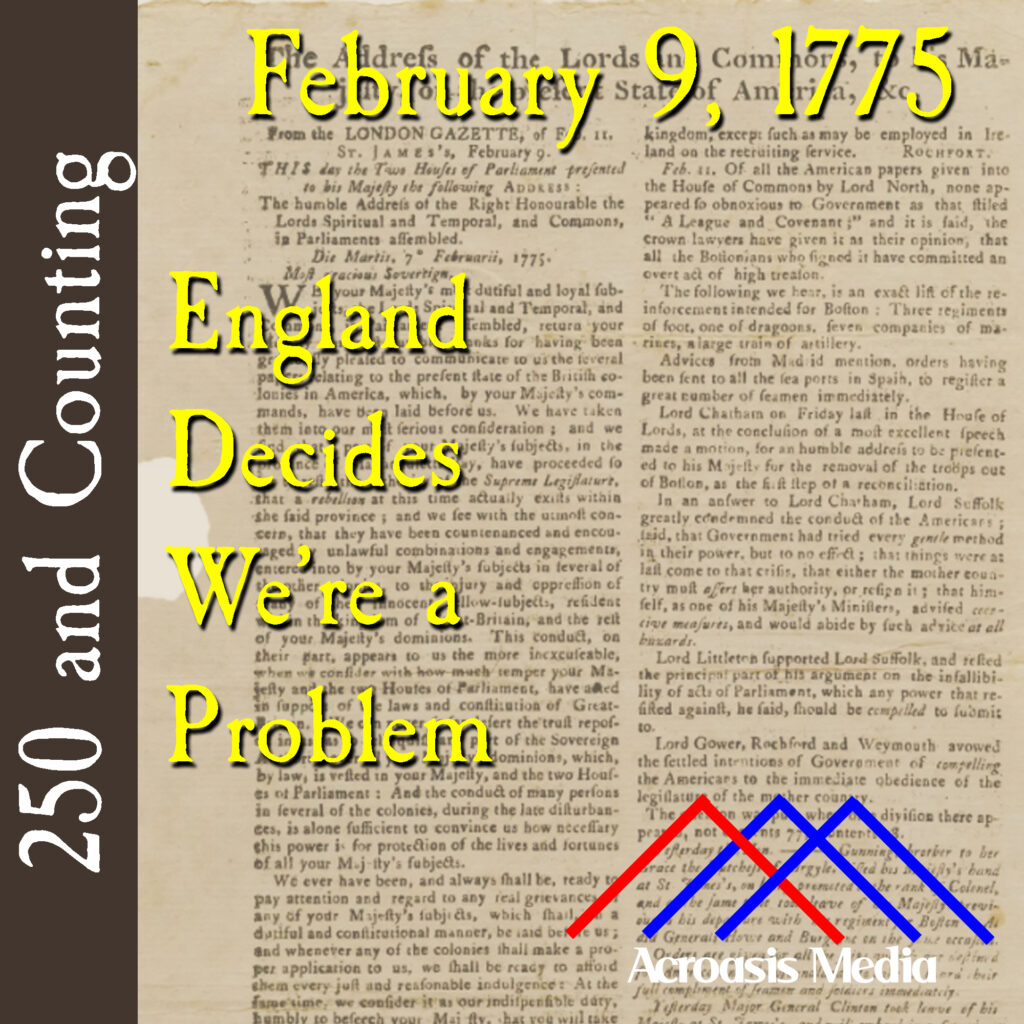
The first week or two of February 1775 could best be described as a series of misunderstandings and communication breakdowns. Any attempts on both sides to reach out with some form of conciliation managed to fail for various reasons.

And during all these breakdowns, the situation on the American side of the pond only got worse as time went on, largely because each side thought that the other wasn’t being responsive.

In the end, however, it didn’t really matter, because as we’ve discussed with the episodes dealing with Massachusettensis and Novanglus debating one another in print, the one thing they agreed upon was that these attempts to reach out were always, at their heart, rooted in some attempt to wrest control from the other party. Both reaching for it, neither attaining it nor caring what the other side’s argument meant at the core.

250 and Counting: February 8, 1775

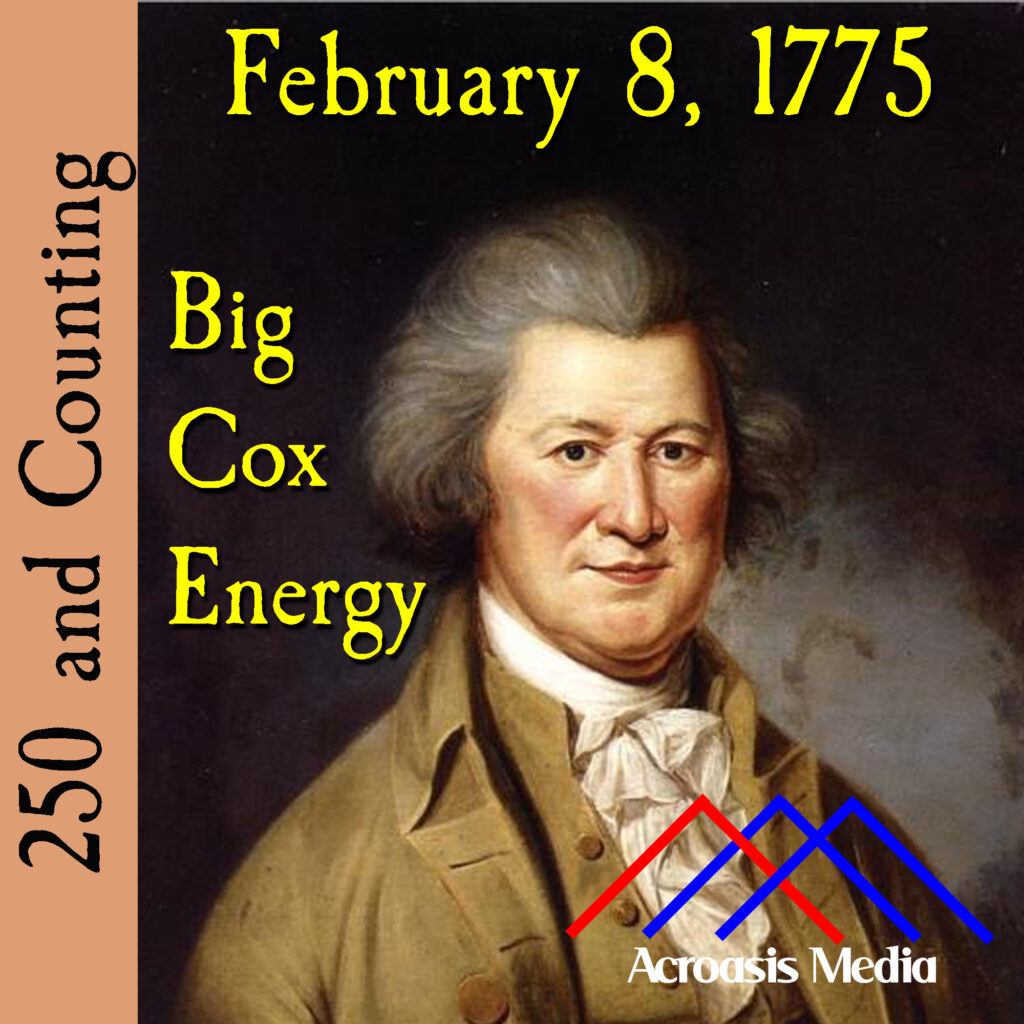
Over the course of a single year—and beginning with this day in 1775—John Cox experienced what any reasonable person would call a “meteoric rise” in his personal and professional fortunes. He started out adjudicating British laws in the Colonies, but moved quickly into assisting with the Colonial resistance effort and subsequently to assisting with the actual war. He did this both materially (as a Quartermaster) and passively (allowing his land to be used by Patriot troops).

He died in 1793, at the age of 60, and even this week he’s probably still more productive than most of us.

250 and Counting: February 7, 1775

In today’s episode, guest voice Lorene Childs tells us the story of Mary Peck Butterworth. Mary was a member of the First Families of Rehoboth, Massachusetts, and a very respected member of the society there.

But for a few years, and for reasons unknown to modern-day people, Mary enjoyed a rather peculiar hobby, one that perhaps should have made her a more famous person than she is. It wasn’t so much in the realm of John Adams and George Washington so much as it is in the realm of, say, Frank Abegnale.

250 and Counting: February 6, 1775

John Adams and Daniel Leonard had an interesting relationship. They were great friends at first, until the British started cracking down on the Colonies. Adams chafed under the Crown’s pressure, while Leonard remained loyal. Ultimately it created a rift between the two men which never quite healed, and it broke Adams’ heart.

When Leonard began submitting essays to the Boston Gazette under the pen name “Massachusettensis,” Adams felt compelled to respond in kind, choosing a pen name of his own, “Novanglus.” It’s not entirely clear that each man knew who the other one was—certainly they did not at that time, but sources appear to differ on whether Adams knew it was Leonard later on—but what is clear is that neither man wrote from the standpoint of the troubles between Britain and the Colonies arising from a simple case of misunderstanding. They both viewed it as each side making a calculated effort to maintain control.

250 and Counting: February 5, 1775

As noted previously, the First Continental Congress composed a Petition to the King asking him for some relief from the Intolerable Acts. The petition arrived in London in mid-December, which turned out to be some bad timing for a number of reasons.

Benjamin Franklin was in town for diplomatic purposes, and he composed a letter to Charles Thomson, the Secretary of the Continental Congress, which summed up the problem: not only was the Petition but one among many, many other documents, it appeared that Parliament didn’t much care what the Colonies thought. And that’s the kind of thing that makes for bad relationships.

Home Page: 250andCounting.com